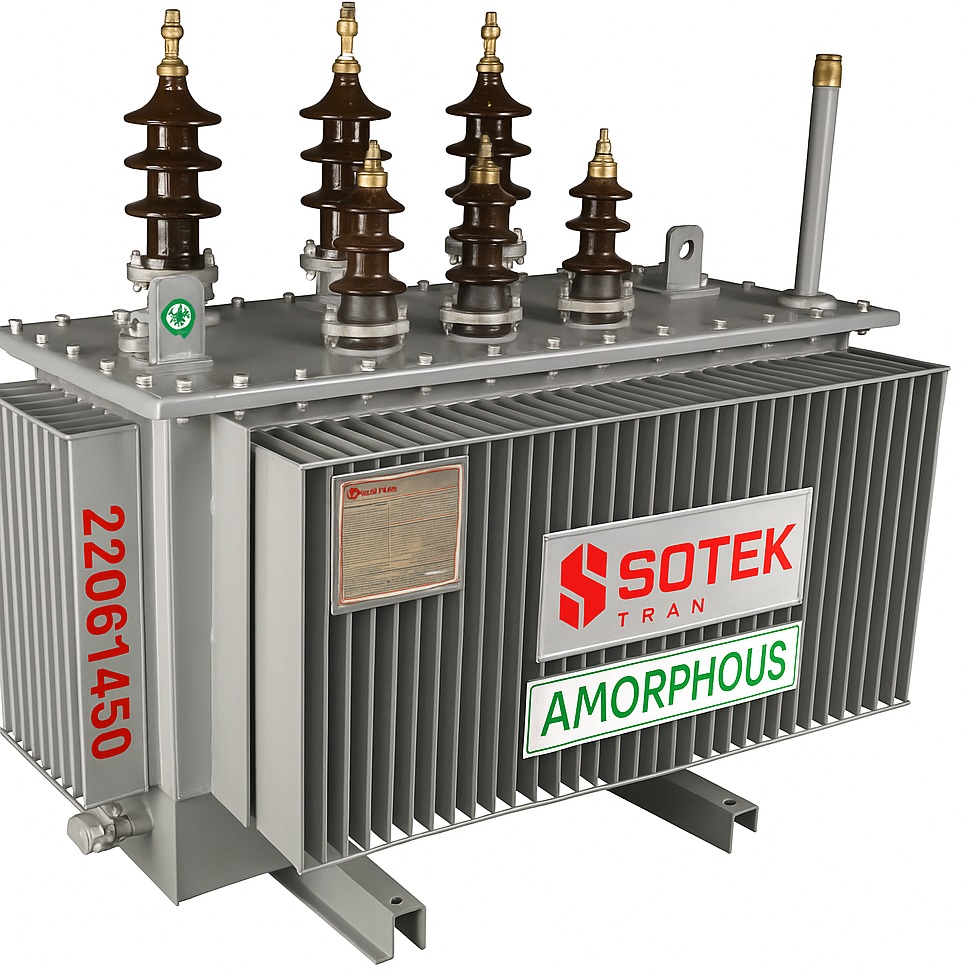
In power distribution networks, transformers are energized 24 hours a day, 365 days a year, continuously dissipating energy through core magnetization losses (no-load core losses, $P_0$), regardless of whether customers are drawing electrical power. As utilities and industrial consumers target aggressive carbon reduction and lower operational expenditures (OpEx), selecting between Amorphous Metal Ribbon and Cold-Rolled Grain-Oriented (CRGO) Silicon Steel has become one of the most critical capital allocation decisions in grid asset management.
1. Atomic Physics & Loss Mechanisms
The fundamental distinction in magnetic efficiency originates at the sub-microscopic atomic level:
- CRGO Silicon Steel (Crystalline Lattice): Produced by hot-rolling and cold-rolling silicon iron sheets (0.23 mm – 0.30 mm thick). Magnetic domains are aligned in the rolling direction, but boundary domain wall friction during alternating 50/60 Hz cycles causes significant hysteresis loss.
- Amorphous Alloy Ribbon (Non-Crystalline Glassy Metal): Formed by ultra-rapid quenching of molten Fe-Si-B alloy at approximately $1,000,000^\circ ext{C}$ per second. The rapid cooling prevents crystals from forming, producing a disordered atomic ribbon only 0.025 mm (25 microns) thick. Because there are no crystalline grain boundaries, magnetic domain walls glide with virtually zero friction, reducing no-load core loss by 70% to 75% compared to standard CRGO.
2. Total Cost of Ownership (TCO) & Loss Capitalization Formula
Evaluating transformers solely based on initial purchase price (CapEx) is a major financial mistake. International utilities evaluate bids using the Loss Capitalization Formula (IEEE C57.120):
Where: $P_0$ = Guaranteed No-Load Loss (kW) | $P_k$ = Guaranteed Full-Load Loss (kW) | $A$ & $B$ = Utility Economic Loss Factors ($/kW over 25-30 years)
In grids where the $A$-factor ranges between $4,000 to $8,000 per kW of no-load loss, an amorphous core transformer typically achieves complete capital payback within 2.5 to 4 years, yielding substantial net cash savings across its 30-year operational life.
3. Engineering Trade-offs: When to Specify Which Technology
| Feature | Amorphous Alloy Transformers | Laser-Scribed CRGO Transformers |
|---|---|---|
| No-Load Core Loss ($P_0$) | Ultra-Low (70-75% reduction) | Standard / Moderate |
| Magnetic Saturation ($B_{sat}$) | ~1.56 Tesla (Requires larger core cross-section) | ~2.03 Tesla (More compact core volume) |
| Audible Sound Level | Requires specialized anti-vibration damping | Naturally quieter magnetostriction |
| Optimal Application | Rural distribution, solar farms, low-average loading grids | Heavy industrial factories, high continuous load factors (>70%) |
SOTEK manufactures both precision laser-scribed CRGO units and automated wound-core amorphous transformers, custom-optimized to meet each client’s specific loss evaluation formula.
