In electrical power distribution systems, transformer magnetic core losses represent a permanent, continuous drain on grid energy. To achieve compliance with strict international energy efficiency regulations (such as EU EcoDesign Tier 2, US DOE 2016, and national green grid mandates), transformer manufacturers must push the boundaries of magnetic core engineering. This technical study examines the physics, processing technology, and loss reduction mechanisms achieved through Laser-Scribed Cold-Rolled Grain-Oriented (CRGO) Silicon Steel.
1. Magnetic Domain Refinement via Laser Scribing
In conventional high-permeability CRGO steel, magnetic domain walls are relatively wide, which leads to high anomalous eddy current losses during rapid 50 Hz or 60 Hz magnetic flux reversals. Laser scribing applies high-intensity focused laser beams across the surface of the steel strip perpendicular to the rolling direction:
- The localized thermal shock introduces controlled microscopic elastic stress lines into the crystal lattice without damaging the surface insulation coating.
- These stress lines subdivide wide magnetic domains into significantly narrower domain stripes (domain refinement).
- Narrower magnetic domains glide with dramatically reduced eddy current friction during AC alternating cycles, reducing no-load core losses by an additional 10% to 15% compared to standard high-grade CRGO.
2. SOTEK Precision Core Assembly Technology
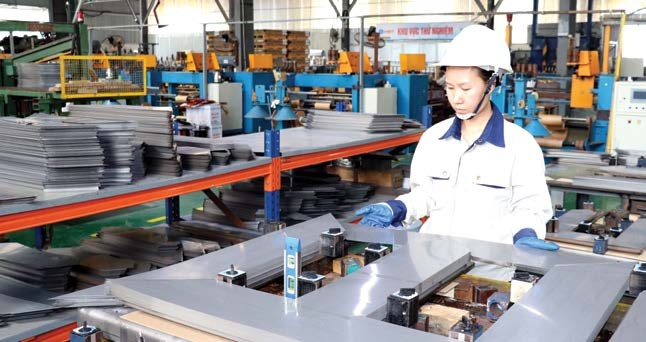
Maximizing the benefits of laser-scribed steel requires precision mechanical handling during transformer core manufacturing at SOTEK’s Tien Son plant:
- Full Step-Lap Mitered Stacking: Eliminates orthogonal 90° flux junctions, routing magnetic flux smoothly along the rolling direction across multi-step mitered joints.
- Torque-Controlled Core Clamping: Excessive mechanical compression stresses induce crystal strain and destroy domain refinement. SOTEK uses precision torque wrenches and non-magnetic clamping bands to maintain optimal clamping pressure ($0.25 – 0.35 ext{ N/mm}^2$).
